
Effective Competitor Keywords Analysis to Improve Your Ranking in SERPs
Dive Into Our Podcast
Why Would You Want to Run Competitive Analyses of Keywords?
Because guessing doesn’t rank websites — data does.
In today’s search landscape, Google is prioritizing intent, authority, and topical depth. That means if your competitor has already mapped this better than you, they’ll win — even with weaker backlinks.
Marketers today use competitor analysis to:
- Discover valuable keywordsthey’re not targeting
- Understand content gaps
- Identify ranking patterns and SERP features
- Reverse-engineer high-performing pages
A common Reddit insight puts it bluntly:
“You don’t need better content. You need better-aligned content
What is Competitor Keyword Analysis?
Competitor keyword analysis is the process of identifying which keywords your competitors rank for — and how you can leverage that data to improve your own rankings.
This includes:
- Organic keywords
- Paid keywords (competitors keywords adwords)
- Featured snippets
- SERP features
- Content gaps
It’s also a critical step in affiliate competitor analysis and paid campaigns, especially when exploring using competitor keywords in adwords.
How Do You Identify SERP Competitors Beyond Obvious Brands?
Most businesses make a mistake here.
Your business competitors are NOT always your SEO competitors.
For example, if you’re in Fintech, your real competition might be blogs, aggregators, or directories — not just brands. That’s why understanding how to identify SERP competitors for Fintech keywords (or your niche equivalent) is critical.
Quick method:
- Search your target keyword
- Analyze top 10 results
- Identify patterns (blogs, product pages, guides, etc.)
- Study their content depth and format
How to Steal Keywords from Your Competitors Without Guesswork
Let’s address the elephant in the room: Can you ethically steal your competitor’s keywords. But it’s the re-sourcing and not just the re-salivation, like this:
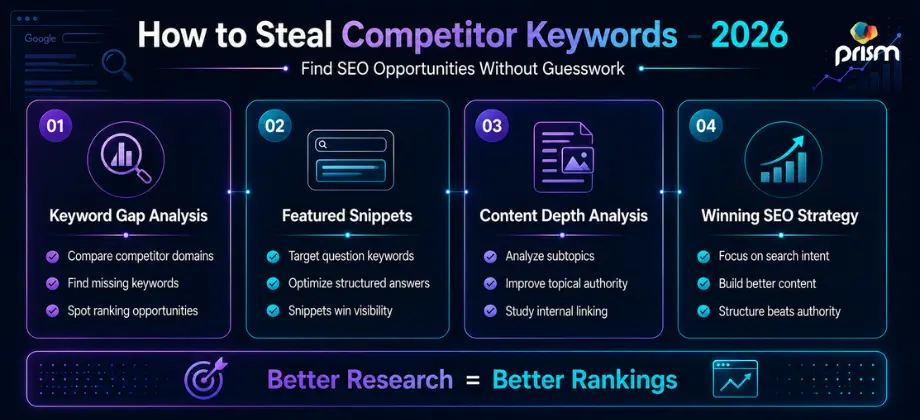
1. Use SEO Tools for Keyword Gap Analysis
Tools such as Ahrefs, SEMrush and SimilarWeb enable you to:
- Compare domains
- Identify missing keywords
- Spot opportunities
This answers a major PPC question: how do you do competitor keyword gap analysis for PPC
2. Analyze Featured Snippet Competitors
Featured snippets will dominate SERPS in 2026. If you want quick wins, here are some things you can do:
- Analyze featured snippet competitors
- Identify question-based queries
- Optimize for structured answers
Pro tip: Most snippet winners are not the highest authority sites — they’re just the most structured.
3. Study Content Depth (Not Just Keywords)
Modern SEO isn’t about stuffing keywords — it’s about topic authority.
Look at:
- Word count
- Subtopics covered
- Internal linking
- Content format
This is where a solid SEO competitor analysis checklist becomes essential.
Competitor PPC Analysis: The Overlooked Goldmine
Most brands ignore paid data — big mistake.
Analyzing competitor PPC analysis reveals:
- High-converting keywords
- Buyer-intent queries
- Ad messaging strategies
This also ties into using competitor keywords in Adwords
If competitors are paying for a keyword consistently, it’s likely profitable.
The Real Problem in 2026: Everyone Has the Same Data
Here’s what most blogs won’t tell you that everyone is using the same tools.
So why do some brands still win?
Because they:
- Interpret data better
- Prioritize search intent
- Build stronger content ecosystem
How to Build a Winning Keyword Strategy from Competitor Insights
1. Focus on Intent, Not Just Volume
High-volume keywords are often saturated.
Instead:
- Target mid-intent queries
- Focus on conversions, not traffic
2. Build Topic Clusters
Don’t just target one keyword.
Create clusters around:
- Primary topic
- Supporting subtopics
- Long-tail variations
3. Combine SEO + PPC Insights
The best-performing brands combine:
- Organic rankings
- Paid keyword data
- Conversion insights
4. Look for Quick Opportunities
Look for:
- Keywords ranking positions 5–15
- Low competition gaps
- Weak competitor content
These are your fastest wins.
Common Mistakes Businesses Still Make
Based on real discussions across Reddit and SEO communities:
- Copying competitors instead of improving on them
- Ignoring search intent
- Targeting keywords without conversion potential
- Not updating content regularly
- Over-relying on tools without strategy
When Should You Consider Professional Help?
If your analysis feels overwhelming, working with experts offering Keyword Research Services in Dubai can help you:
- Identify gaps faster
- Build scalable strategies
- Align SEO with business goals
Many companies also partner with SEO agencies in Dubai to derive meaningful insights from the raw data which can be applied for business growth.
To Sum It Up
In 2026, you must not chase after the successful brands for strategic positioning but those who:
- Understand intent
- Build better content
- Act faster on insights
Just remember it is not about looking for your competitors’ keywords but about identifying their weaknesses. That’s where your growth lies.

About The Author: Lovetto Nazareth
Lovetto Nazareth is the Founder & CEO of Prism Digital, a Dubai-based digital marketing and advertising agency he started nearly two decades ago from a laptop and a vision, as he puts it, to one of the region's established full-service agencies spanning SEO, PPC, social media, web design, and PR.
Over more than 19 years in advertising and digital marketing, Lovetto has guided thousands of campaigns across the UAE and GCC, working across sectors from real estate to hospitality to fintech. He writes and speaks on digital transformation and marketing strategy, and has contributed opinion pieces to Campaign Middle East, one of the region's leading marketing trade publications.
He takes a data-first approach to growth testing, measuring, and iterating rather than relying on guesswork and outside of work he's an adventure sports enthusiast and a singer-songwriter.