
What Is a Deep Link? Deep Linking in Ecommerce Explained for 2026
Dive Into Our Podcast
So, What Is a Deep Link — Really?
The simplest way to explain it: a regular link takes someone to your homepage. A deep linktakes them directly to a specific page, product, category, or in-app screen — skipping every step in between. Think of it as the difference between handing someone your company address and walking them directly to the product they came to buy.
On the web, deep links are the standard URLs you already use — any URL that points to a page other than your homepage is technically a deep link. But in mobile, the concept becomes more layered and more powerful. Mobile deep linking refers to URLs that open a specific screen inside an installed app, rather than just launching the app or redirecting to a mobile browser.
On iOS, this is done through Universal Links. On Android, through App Links (formerly intent URLs). When implemented correctly, tapping something what is called a deep URLin an email or ad opens your app at exactly the right screen — no redirects, no friction, no lost customers.
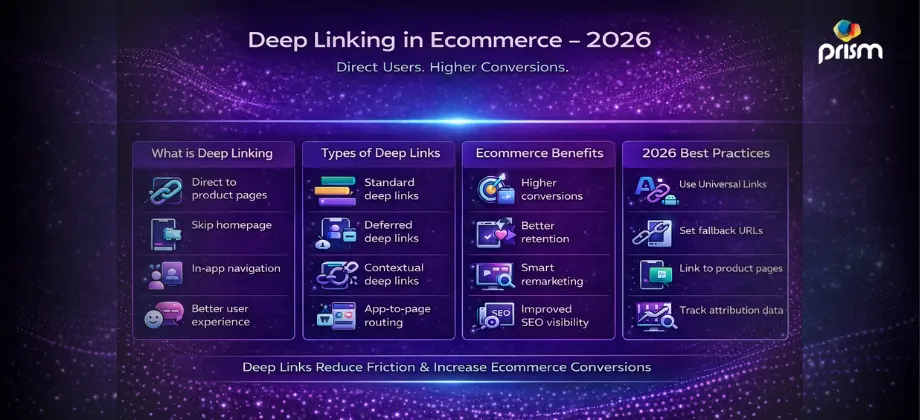
The Three Types of Deep Links Ecommerce Brands Need to Know
1. Standard Deep Links
These use a URI scheme (such as myapp://product/123) to send an existing app user to a specific in-app location. They work perfectly when the app is already installed — but return an error if it isn’t. Best used in push notifications and in-app campaigns targeting your existing user base.
2. Deferred Deep Links
The smarter version. The user is taken to App Store or Google Play if the app isn’t installed. They download and open the app, and they arrive at the exact product page that the original link pointed to — not the homepage. This is very important for paid social and email campaigns for cold audiences.
3. Contextual Deep Links
The most sophisticated type. They have user data — a referral source, a promo code, a personalised onboarding flow — and the destination receives it too. The app already knows who referred them and what offer to show if someone clicks a referral link. This is how expo deep linking and cutting edge native mobile solutions such as Branch, Adjust and AppsFlyer enable personalised acquisition at scale.
How Deep Linking Works
You don’t have to be a developer to learn how deep link works — but understanding the mechanics allows you to make better strategic decisions.
- A user clicks a deep link in an email, SMS, ad or social.
- The operating system of the device verifies that the app is installed and the domain is authenticated to be associated with that link (this is the Universal Link / App Link authentication process).
- The operating system immediately launches the app and directs it to the right page if the app is installed and authenticated.
- If the app is not installed, a fallback URL redirects the user to the web version of the content or to the app store — depending on how the link is configured.
The fallback is critical. Without it, broken links kill the user journey entirely. In 2026, with Firebase Dynamic Links officially deprecated, most ecommerce teams are migrating to alternatives like Branch.io, Adjust, or AppsFlyer for managed deep link infrastructure — all of which handle fallbacks automatically.
What Is Deep Linking in SEO — And Why It Changes Your Rankings
What is deep linking in SEO? It is the practice of earning or building links that point to specific internal pages — product pages, category pages, blog posts — rather than only your homepage. And it matters enormously.
Google treats a site whose only backlinks point to its homepage as unnatural. A good link profile will spread equity among the pages that actually convert — your product detail pages, your category pages, your landing pages. Every backlink to a deep URL also directly passes authority to that page, which enhances its ability to rank for the keywords it is trying to target.
Mobile: For mobile Google indexes app content via Universal Links and Firebase App Indexing. When your mobile app deep linkingis correctly implemented, your app’s content can appear directly in mobile search results with an “Open in App” prompt — giving you a second presence in the SERPs without additional ad spend.
The Real Benefits of Deep Linking for Ecommerce Websites
Benefits of deep linking for ecommerce websites go well beyond the technical. Here is what actually changes in your business:
- Higher conversion rates. Mobile app users who are taken directly to a product convert up to 3x more than those landing on a homepage. Every extra tap you remove is a drop-off point you eliminate.
- Stronger retention. Deferred deep links that carry context through the install process show consistently higher retention rates — users who get what they came for stay.
- Smarter remarketing. Abandoned cart push notifications with deep links that take the user directly back to their cart drive re-engagement at a fraction of the cost of display retargeting.
- Better attribution. Contextual deep links carry campaign data across the install journey, letting you see exactly which channel, ad, or influencer drove a specific conversion.
Improved organic discoverability. When deep links are indexed by search engines, they expand your SERP footprint. More indexed pages means more entry points for organic traffic across a wider range of search queries.
How to Implement Deep Linking in Your Ecommerce Website
How to implement deep linking in ecommerce website depends on your stack, but the strategic principles apply universally:
Build a deep link SEO strategy for your product and category pages
Your PDPs and category pages are where revenue is made, but they are the hardest pages to earn backlinks for. A deep linking SEO strategy for ecommercefocuses link-building efforts on exactly these pages — through product reviews, guest content, digital PR, and sponsorships that earn contextual, keyword-rich links into the pages that convert.
Time for Universal Links (iOS) and App Links (Android)
Use verified universal links so that your domain’s deep links open the app directly without triggering a browser redirect. This is the foundation of any mobile app deep linkingstrategy and requires coordination between your dev team and your digital asset links file on the domain.
Always configure a fallback
Every deep link must have a fallback URL for users without the app. Send them to the web version of the same content — not the homepage. A user who clicked a link for a specific product and lands on a homepage is a lost conversion.
Deploy deep links across every marketing channel
Email campaigns, SMS, push notifications, paid social, QR codes, influencer links — every channel benefits from deep linking. An ecommerce SEO agencywith real platform expertise will configure these across channels rather than treating deep linking as a standalone technical project.
2026 Challenges
There has been a massive change from 2025 to 2026 in the deep linking landscape.. Google’s Firebase Dynamic Links were fully deprecated, leaving many ecommerce teams scrambling for alternatives. If you were relying on Firebase for your link management, migrating to Branch.io, Adjust, or AppsFlyer is now urgent — not optional.
Privacy regulation has also tightened the attribution picture. Apple’s App Tracking Transparency (ATT) framework limits the data that contextual deep links can carry on iOS without user consent. This has not killed contextual linking — but it has made the implementation more nuanced and the role of e-commerce SEO experts who understand the full technical and regulatory picture more important than ever.
URI schemes (myapp://) remain in use but carry a security risk — any app can register the same scheme, creating hijacking vulnerabilities. In 2026, best practice is Universal Links and App Links exclusively, which tie your deep links to verified domains.
Conclusion
Deep linking is not a developer checkbox. It is a conversion strategy, a retention strategy and an SEO strategy all at once. By 2026, as mobile commerce continues to dominate and shopping journeys based on apps become the norm, every ecommerce brand that’s serious about growth is going to need to figure this out. The good news is that the execution is well-understood and results are quantifiable. The bad news is that most stores are still sending everyone to their homepage.
If you want to build a deep linking strategy that is technically sound, SEO-aligned, and integrated across your marketing channels, the Best SEO Agencies in Dubaithat specialise in ecommerce — like Prism Digital — can audit your current link structure, identify the gaps, and implement a solution that compounds over time. Deep linking is one of those things that, once set up correctly, keeps working for you. The question is whether you’ve set it up yet.

About The Author: Lovetto Nazareth
Lovetto Nazareth is the Founder & CEO of Prism Digital, a Dubai-based digital marketing and advertising agency he started nearly two decades ago from a laptop and a vision, as he puts it, to one of the region's established full-service agencies spanning SEO, PPC, social media, web design, and PR.
Over more than 19 years in advertising and digital marketing, Lovetto has guided thousands of campaigns across the UAE and GCC, working across sectors from real estate to hospitality to fintech. He writes and speaks on digital transformation and marketing strategy, and has contributed opinion pieces to Campaign Middle East, one of the region's leading marketing trade publications.
He takes a data-first approach to growth testing, measuring, and iterating rather than relying on guesswork and outside of work he's an adventure sports enthusiast and a singer-songwriter.